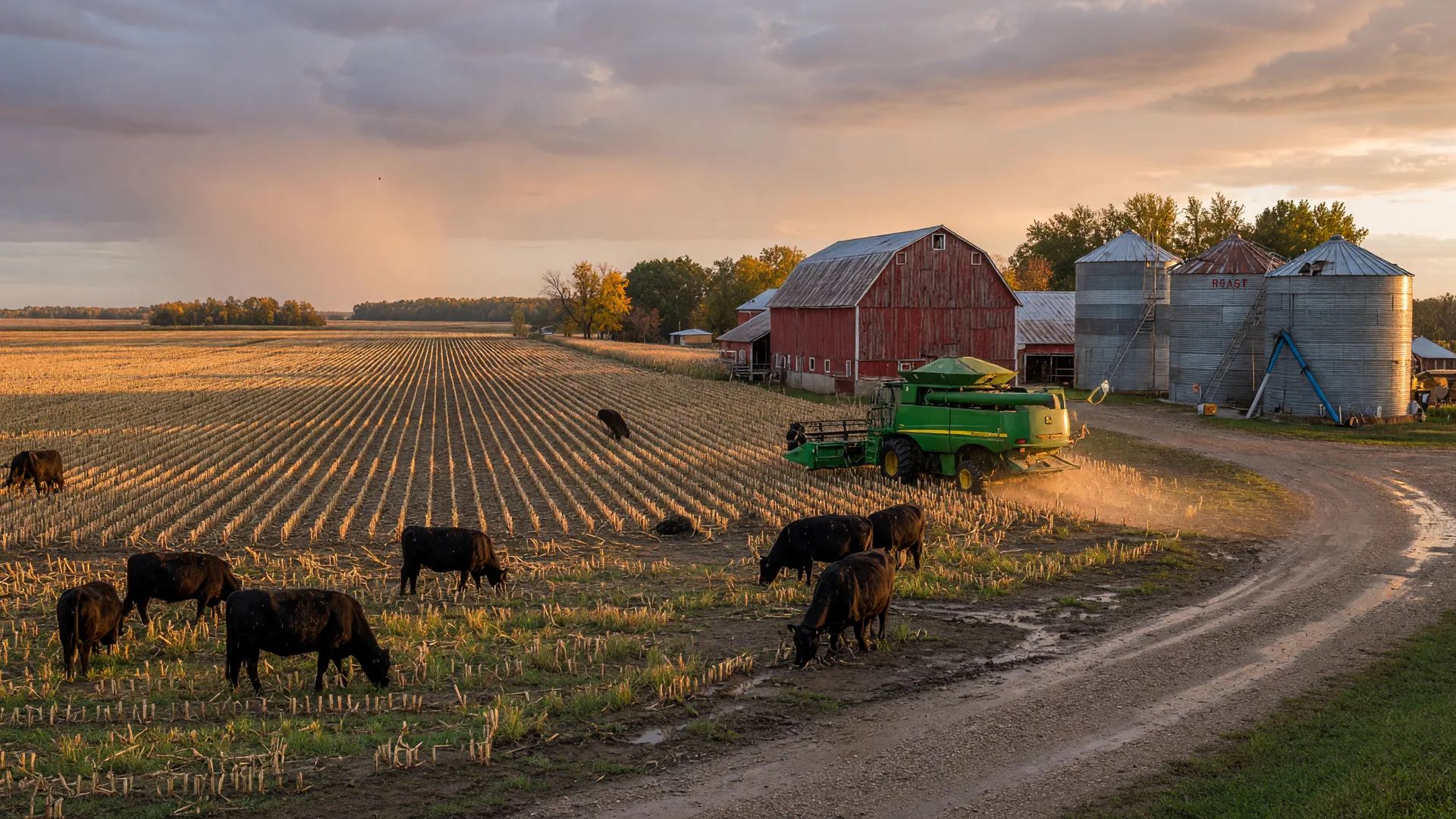
Friday was the report day the whole trade had been waiting on, and the October WASDE delivered a stunner. USDA raised the corn yield to 181.2 bushels an acre, well above the roughly 177.7 the trade expected, and December corn briefly traded limit-down before settling at $4.79 3/4, down 20 1/2 cents. Soybeans did the opposite, closing up 4 1/2 cents at $12.92 as demand absorbed a record yield. Cattle caught the falling corn and rallied hard: December live up $3.50 to $227.05 and November feeders up $7.07 to $341.95. December Chicago wheat slipped 12 1/4 cents to $6.71 under the report and fresh Black Sea ceasefire talk. Here is the straight talk on Friday's session and the next 48 hours.
Cattle
Fri Oct 9 close: Dec live $227.05/cwt, up $3.50. Nov feeder $341.95/cwt, up $7.07
What Happened
Friday's cattle rally was a feed-cost story first. December live cattle settled at $227.05, up $3.50, with the front-month October contract up $3.10 to $224.97, and November feeders jumped $7.07 to $341.95, their highest weekly close since early July. The driver was the corn break: the WASDE cut the cost of putting pounds on cattle, and feeders, the most feed-sensitive contract on the board, led the charge. Cash trade was a quiet, late-week affair. Bids surfaced Friday at $220 in Kansas and at $218 live and $345 dressed in Nebraska. The weekly FOB live trade was steady to $2 higher in Nebraska at mostly $222, and steady to $2 lower in the western Corn Belt at $218 to $220, with dressed trade steady at $345. Boxed beef held up: the Choice cutout closed at $374.70, down 15 cents, with Select up $4.29 to $356.02 and the Choice-Select spread at $18.68 on 91 loads.
Drovers' CAB Insider notes cash slipped narrowly last week as larger market-ready supplies in the North, Nebraska, Iowa, and South Dakota, pressed the most actively traded region. The RFD-TV Cow Guy team, Scott Shellady's daily Cow Guy Close tape, says tighter slaughter supplies are increasing competition for market-ready cattle, with negotiated grid cattle bringing $2 to $3 per hundredweight above formula sales. Feeder cattle are at record-high prices with steep break-evens and losses on unhedged closeouts, per Drovers' John Nalivka, so Friday's rally is real margin relief, not just a bounce. Scott Shellady's Cow Guy Close on RFD-TV keeps the daily tape in front of the trade every afternoon, and the cash-versus-feed-cost story has been the headline all week.
Next 48 Hours Outlook
Monday and Tuesday come down to whether cash trade develops at or above last week's levels and whether corn holds the WASDE break. If corn stays lower, feeders have support; cheaper corn is the single biggest input in the feeder margin. Watch boxed beef too. Drovers' fourth-quarter outlook has Choice stabilized in the $375 to $380 area, with ribeyes and strip loins at record levels since early August, but analysts project a $15 to $20 cutout decline and a $9 to $12 fed-cattle decline if added imports weigh on the market. The next Cattle on Feed report does not land until Friday, October 23, so the next two sessions are cash, cutouts, and the kill. Watch whether December live can hold $227.
Corn
Fri Oct 9 close: Dec contract $4.79 3/4/bu, down 20 1/2 cents after the WASDE
What Happened
The October WASDE was the whole ballgame, and it hit corn bulls square. USDA raised the 2026 corn yield to 181.2 bushels an acre, up 2.7 from September's 178.5 and well above the roughly 177.7 the trade expected, lifting production to 16.034 billion bushels and 2026/27 ending stocks by 282 million bushels to 1.849 billion. December corn briefly traded limit-down and settled at $4.79 3/4, down 20 1/2 cents, a six-week low. Analysts called it a shock that hits corn bulls, with the heavier supply pressing prices into 2027. Harvest is still running behind: corn was 23 percent harvested as of October 4, 4 points behind the five-year average of 27 percent, with the crop rated 54 percent good to excellent after the wet late summer in the western Corn Belt. Wisconsin's mid-October outlook leans warmer and drier than normal, which should let combines catch up.
Next 48 Hours Outlook
The next crop progress report lands this week and gives the first read on how much combining caught up over the weekend. A dry window in the forecast favors harvest, and every day of good weather puts more corn in the bin and more pressure on the deferred months. The trade will also watch whether export demand steps in after the break; corn sales have been the soft spot all fall. $4.75 to $4.80 is the line in the sand now, and the market will test whether the WASDE number holds or gets traded back.
Soybeans
Fri Oct 9 close: Nov contract $12.92/bu, up 4 1/2 cents
What Happened
The WASDE raised the soybean yield to a record 53.1 bushels an acre, up 0.3 from September's 52.8, with production up to 4.562 billion bushels. But November soybeans closed up 4 1/2 cents at $12.92 in an impressive comeback from the lows, because demand absorbed the supply. USDA raised the 2026/27 export forecast by 10 million bushels, holding the increase in ending stocks to just 5 million bushels at 315 million, and analysts read the report as only slightly bearish for beans. Demand is the story: China has been the top buyer, with state traders purchasing around 1 million tons in cargoes and Sinograin booking December through February Gulf shipments, purchases approaching half of China's 25 million metric ton annual commitment. Strong domestic crush and biodiesel demand are supporting the market too.
Next 48 Hours Outlook
Beans are a demand trade now. The question is whether China keeps buying after the WASDE surprise and whether Thursday's weekly export sales report shows another strong week. If beans hold $12.90, the market is telling you the demand story is real. The record yield keeps a lid on rallies, but the demand side is doing the heavy lifting, and at these levels the bean-corn ratio keeps acres interesting for 2027.
Wheat
Fri Oct 9 close: Dec Chicago SRW $6.71/bu, down 12 1/4 cents
What Happened
December Chicago wheat settled at $6.71, down 12 1/4 cents, under a WASDE that raised U.S. 2026/27 ending stocks by 23 million bushels to 740 million and cut the export forecast by 25 million bushels to 750 million on slower hard red winter and hard red spring sales. Global ending stocks were raised too, and the corn shock dragged the whole complex. The demand side was not all bad: weekly export sales totaled 451,600 metric tons, led by the Philippines, South Korea, and Japan. But the Black Sea headline machine flipped bearish over the weekend. President Trump said Monday that Russia and Ukraine had agreed to an immediate energy ceasefire, raising hopes of reduced Black Sea shipping disruption. Ukraine and Russia together account for more than a quarter of global wheat exports, and Ukrainian drone strikes in August reportedly destroyed more than 90 percent of Russia's Black Sea and Azov grain export capacity, with Russian exports at 15-year lows. Every round of truce talk sells the premium.
Next 48 Hours Outlook
Monday and Tuesday are a Black Sea headline trade. If the ceasefire talk produces anything real, wheat gives up more premium; if it stalls, $6.70 snaps back fast. USDA's export forecast cut is a reminder that U.S. wheat is not catching the demand right now, and Thursday's export sales report answers whether that changes. Watch the dollar too; a firm dollar is a headwind for every grain.
What This Means for
The Bottom Line
Friday was a report-day split: December corn down 20 1/2 cents to $4.79 3/4 after the WASDE raised the yield to 181.2 bushels an acre, November soybeans up 4 1/2 cents to $12.92 on demand, December wheat down 12 1/4 cents to $6.71 on stocks and ceasefire talk, and cattle surging on cheaper feed with December live up $3.50 to $227.05 and November feeders up $7.07 to $341.95. The next 48 hours come down to cash cattle, Black Sea headlines, and whether the drier forecast lets harvest catch up. For Wisconsin farm and land sellers, the through-line is unchanged: land values held firm at a record $7,238 an acre average for 2025, fall auctions are running strong, and a grain report day is noise against the value story in your ground. If you have been thinking about listing, the fall window is open.
I watch these markets every day because they tell me what the buyers I work with are thinking. If you want an honest read on what your farm or land is worth in this market, give me a call. I will walk your ground with you and tell you straight what I see.
Read More on the Site
This update lives under our Cattle and Cash Crops section, where you can find deeper guides on cattle property, crop land, and what Wisconsin rural land is really worth.