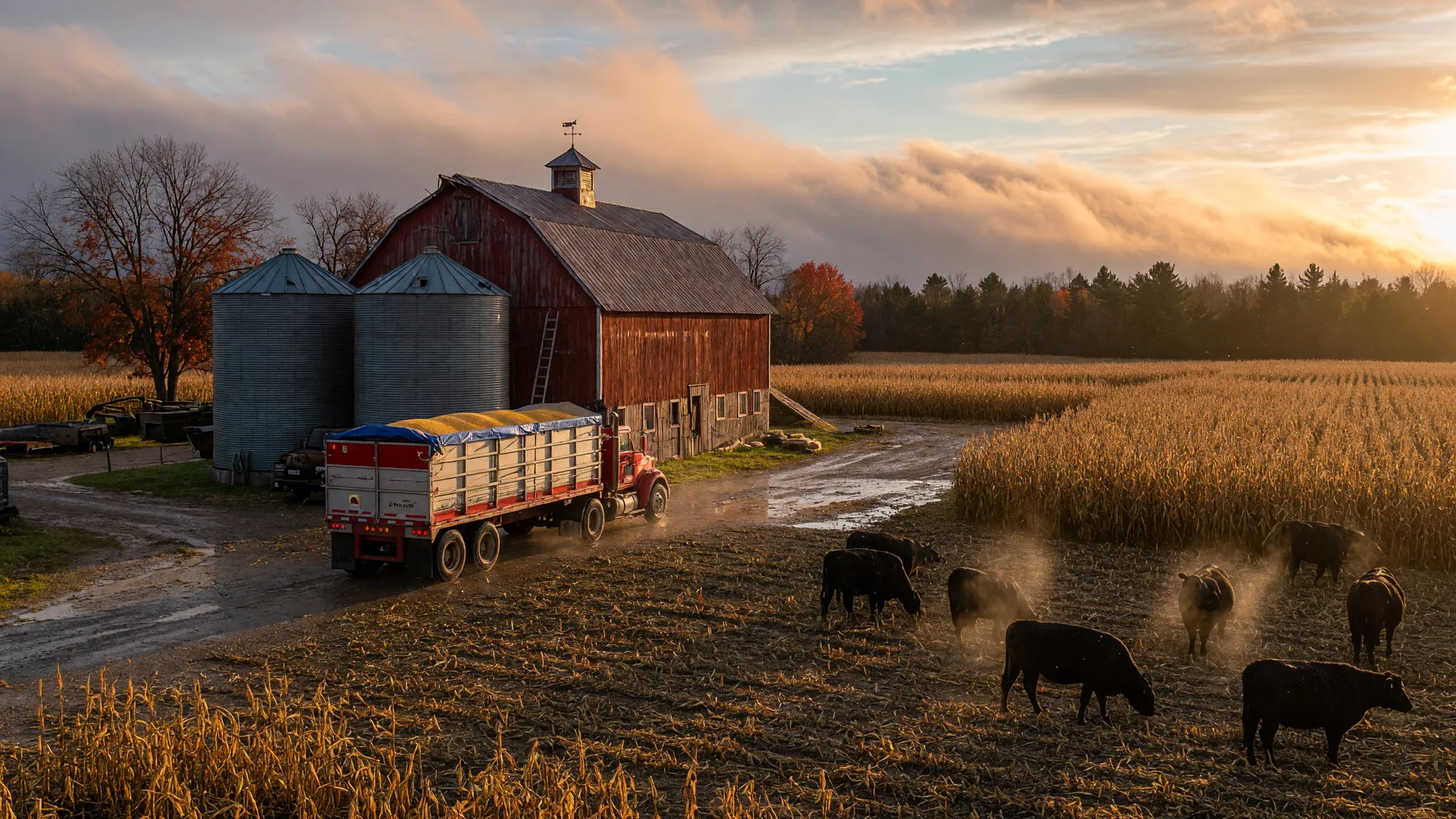
Wednesday was the last completed session, and the grain trade was still chewing on the October WASDE. December corn slipped 2 cents to $4.80 3/4 on follow-through selling after the report raised the corn yield to a record 181.2 bushels an acre. November soybeans lost 6 1/2 cents to $12.77 1/4 near a six-week low despite fresh Chinese buying, December Chicago wheat bucked the trend, up 4 cents to $6.73 1/4 on fresh Black Sea risk, and cattle backed off a two-day run with December live down $1.25 to $225.12 and November feeders down $2.57 to $338.45. Overnight into Thursday, wheat firmed on most boards and MATIF corn jumped. Here is the straight talk on the last 24 hours of trading.
Cattle
Wed Oct 14 close: Dec live $225.12/cwt, down $1.25. Nov feeder $338.45/cwt, down $2.57
What Happened
Wednesday's pullback followed Tuesday's run to fresh multi-month highs. December live cattle settled at $225.12, down $1.25, with February live down $1.15 to $227.42 and live contracts broadly off 30 cents to $1.25. November feeders fell $2.57 to $338.45. The day before, November feeders touched a three-month high at 341.025 before closing just 0.075 lower as they met chart resistance at the 200-day moving average, and live cattle tested multi-month highs of their own on tight supplies and good beef demand.
The driver Wednesday was profit-taking into a quiet cash market. Cash trade stayed thin midweek: Texas feedlots were asking $230 live, and the Fed Cattle Exchange showed $226 sales on light volume, with sellers holding out for higher bids and the bulk of trade expected Thursday and Friday. Drovers framed the backdrop in its October 13 piece "Cattle Market Standoff: Shrinking Supply Meets Stalled Wholesale Beef Prices," noting USDA cut 2026 and 2027 beef production forecasts to their lowest mark since 2015, with federally inspected steer slaughter down roughly 6 percent year over year through late summer. Choice boxed beef has plateaued around $374 to $379 after a weekly average near $388 in late August; the USDA October 13 summary put Choice at $373.35, down, with Select higher. Scott "The Cow Guy" Shellady's Cow Guy Close on RFD-TV has been on the tape daily, airing Episode 202 on October 13 and Episode 203 on October 14, and negotiated cattle grids have been gaining an edge over formula sales as slaughter supplies tighten.
Corn
Wed Oct 14 close: Dec contract $4.80 3/4/bu, down 2 cents
What Happened
December corn settled at $4.80 3/4, down 2 cents, with March down 2 1/4 cents to $4.94 1/4. ADM noted the market traded 1 to 2 cents lower while holding within the prior day's range. The pressure was follow-through selling after the October 9 WASDE shock: USDA raised the 2026 corn yield to 181.2 bushels an acre, up from 178.5 in September, with a big Nebraska increase adding roughly 106 million bushels to production. Carryout ballooned, and USDA trimmed the season-average farm price 10 cents to $4.70. Corn briefly traded limit-down on report day before recovering.
Harvest is adding its own pressure. Corn was 33 percent harvested as of October 11, up 10 points in a week but still the slowest pace in seven years and below the 39 percent five-year average. Broad risk-off selling tied to a hot CPI print, 3.7 percent inflation, kept a lid on any bounce. Exports were the one supportive counterweight: USDA raised the corn export forecast by 25 million bushels, and weekly inspections of 51.3 million bushels for the week through October 8 ran at the higher end of estimates.
Soybeans
Wed Oct 14 close: Nov contract $12.77 1/4/bu, down 6 1/2 cents
What Happened
November soybeans settled at $12.77 1/4, down 6 1/2 cents, with January down 8 cents to $12.92 and futures pressing near a six-week low. Supply was the driver. USDA raised 2026 production to 4.562 billion bushels from 4.535 billion, and harvest is running at about 46 percent complete, moving a record-large crop to market and keeping a lid on any rally.
China cushioned the losses. Chinese state buyers took 8 to 10 Panamax cargoes, the first US deals since the Trump-Xi summit, and USDA confirmed a 470,000-ton sale to China for 2026/27. Even so, overall Chinese purchases were still seen as slower than hoped. Weakness in soybean oil on US biofuel policy uncertainty added downward pressure on the whole complex.
Wheat
Wed Oct 14 close: Dec Chicago SRW $6.73 1/4/bu, up 4 cents
What Happened
December Chicago wheat settled at $6.73 1/4, up 4 cents, near the session high. The ADMISI London wheat report had the contract a cent firmer at $6.70 1/4 after touching $6.63 earlier. The bounce halted four declines in five sessions that had taken the contract to its lowest close since late August.
The bearish October 9 WASDE kept a lid on rallies: US 2026/27 ending stocks were raised 23 million bushels to 740 million, about 20 million above trade expectations, and the export forecast was cut 25 million bushels. But fresh Black Sea risk gave wheat its bid. Drone strikes hit two cargo ships off Bulgaria on October 13, one of them sank, dashing hopes of a shipping truce and keeping a war-risk premium in the market. Slow US winter wheat planting gave support, while a firmer dollar at 18-month highs and weak US export demand were the headwinds.
What This Means for
The Bottom Line
Wednesday's close was a WASDE-week drift: December corn down 2 cents to $4.80 3/4, November soybeans down 6 1/2 cents to $12.77 1/4 near a six-week low, December wheat up 4 cents to $6.73 1/4 on Black Sea risk, and cattle backing off with December live down $1.25 to $225.12 and November feeders down $2.57 to $338.45. Overnight into Thursday, wheat firmed on most boards and MATIF corn jumped. No forecasts here, just the tape. For Wisconsin farm and land sellers, the through-line is unchanged: the supply side of the cattle story is the tightest in years, harvest is the slowest in seven years, and a session's grain move is noise against the value story in your ground.
I watch these markets every day because they tell me what the buyers I work with are thinking. If you want an honest read on what your farm or land is worth in this market, give me a call. I will walk your ground with you and tell you straight what I see.
Read More on the Site
This update lives under our Cattle and Cash Crops section, where you can find deeper guides on cattle property, crop land, and what Wisconsin rural land is really worth.