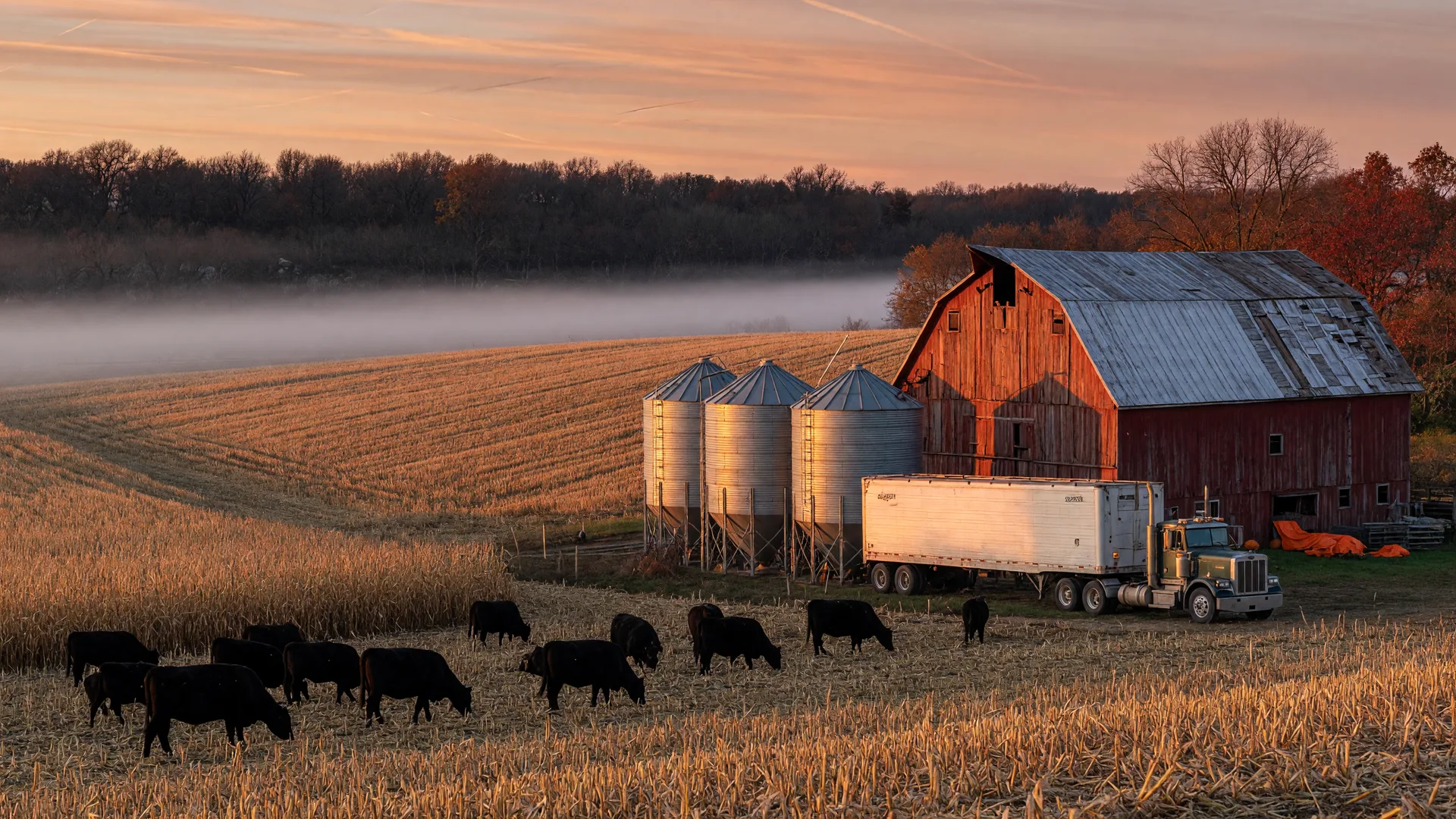
Wednesday was the last completed session, and it split the board the way this fall keeps doing: cattle pushed to three-month highs on a supply story that just will not quit, while the grains stayed heavy, with corn scraping back a small gain off a three-month low and soybeans and wheat giving up more ground. December live cattle settled at $231.12, up 95 cents, December corn rose 1 1/4 cents to $4.63 1/4, November soybeans slipped 3 cents to $12.45 1/4, and December Chicago wheat dropped about 15 cents to $6.28 1/4. Cash cattle trade stayed quiet all day, with everyone waiting on Friday's Cattle on Feed report, and the grain trade kept selling the harvest. Here is the straight talk on the last 24 hours of trading.
Cattle
Wed Oct 21 close: Dec live $231.12/cwt, up $0.95. Feb live $233.82/cwt, up $0.72. Nov feeder $348.82/cwt, up $2.52
What Happened
Live and feeder cattle futures rallied again Wednesday, with live cattle breaking to three-month highs. December live cattle settled at $231.12, up 95 cents, and February live rose 72 cents to $233.82, with live contracts up roughly 77 cents to $1.07 across the board. Feeders led the charge: November feeders jumped $2.52 to $348.82, and January feeders rose $3.20 to $345.82, underpinned by cheap corn. The CME Feeder Cattle Index eased $1.29 to $342.16 as of October 19.
Cash trade was the quiet part of the day. Bids had not surfaced midweek, asking prices were floated near $232 live in the South but not yet established in the North, and traders sat on their hands ahead of Friday's USDA Cattle on Feed report. The demand side held its own: the latest boxed beef cutout had Choice at $371.58, down 73 cents, with Select up $6.86 to $359.91, and estimated slaughter ran 112,000 head, up from 110,000 a week earlier.
The tape and the talk both point the same way. Drovers' CAB Insider called the fed cattle trade bullish with carcass weights creeping up, and AgWeb's Michelle Rook quoted Brad Kooima of Kooima Kooima Varilek that the charts look positive but a healthy correction is likely, with Kooima skeptical of USDA's new regional cash cattle report set to launch October 26 under the Livestock Mandatory Reporting program. Scott Shellady's Cow Guy Close, Episode 206, aired on RFD-TV and Rural Radio SiriusXM Channel 143 on October 19.
Corn
Wed Oct 21 close: Dec contract $4.63 1/4/bu, up 1 1/4 cents. Mar contract near $4.77/bu
What Happened
December corn settled at $4.63 1/4, up 1 1/4 cents and near the daily high, snapping a six-session losing streak that had taken it down nine of the last ten days. The turnaround was a bottom, not a breakout: the contract broke to a fresh three-month low in early trading, tested support at $4.57 1/4, the August 6 low, and then reversed to close back above it. March corn settled near $4.77.
The drivers were a tangle of pressure and support. On the pressure side, funds and algorithmic sellers had been hammering the board, harvest is finally rolling, and export inspections came in weak at 672,475 metric tons for the week ending October 15, down about 49 percent from a year ago and the lowest in months. On the support side, a Taiwan tender for 65,000 metric tons of corn reminded the market there is still buying, an easing dollar and a roughly $2 rally in crude oil lent a hand, and traders kept questioning USDA's national corn yield estimate. USDA's October 19 Crop Progress showed corn 44 percent harvested as of October 18, eight points behind the five-year average, but a dry week in the central US has combines running hard and producer hedge selling moving with it.
Soybeans
Wed Oct 21 close: Nov contract $12.45 1/4/bu, down 3 cents. Dec meal $348.30/ton, down 40 cents. Dec oil 65.97 cents/lb, down 76 points
What Happened
November soybeans settled at $12.45 1/4, down 3 cents, the eighth straight daily decline, after recovering about 10 cents off the intraday lows. December soybean meal settled at $348.30, down 40 cents, and December soybean oil fell 76 points to 65.97. Support sits at the 100-day moving average near $12.27 1/4, with resistance at the 10-day average near $12.70.
Fund and technical selling did the work, with a fast harvest keeping hedge pressure on the board. The demand headlines kept coming and could not lift it. USDA confirmed flash sales of 134,000 metric tons of 2026/27 soybeans to China and 165,000 metric tons to Spain, Spain's first daily US soybean sale since December 2024. It was the sixth consecutive business day with a China sale, after a 612,000-ton China sale the day before, and Chinese state firms booked another 10 to 13 cargoes, pushing China past 60 percent of its 25-million-ton 2026/27 US buying target. Crush margins slipped about 6 cents to $2.47, and Sinograin said it will auction 512,000 tons of previously imported soybeans on October 27.
Wheat
Wed Oct 21 close: Dec Chicago SRW $6.28 1/4/bu, down about 15 cents. Dec KC HRW near $6.73/bu, down about 18 cents. Dec Minneapolis spring $6.51 1/2/bu, down 10 1/4 cents
What Happened
Wheat was the day's biggest loser, leading the grain complex lower for a fifth straight session. December Chicago soft red winter wheat settled at $6.28 1/4, down about 15 cents to a multi-week low, December Kansas City hard red winter wheat closed near $6.73, down about 18 cents, and December Minneapolis spring wheat settled at $6.51 1/2, down 10 1/4 cents.
The driver was peace talk, and the premium coming out of the board. Reports that US envoy Steve Witkoff was set to meet Vladimir Putin on October 21, and talk of a possible resumption of trilateral Ukraine-US-Russia talks, raised expectations that restricted Black Sea grain flows could resume, and the market unwound the risk premium it had built up. None of that changes the near-term supply picture, which is still tight: USDA cut Russia's 2026/27 export outlook to 40 million metric tons, a five-year low, and SovEcon is even lower at 36.7 million. But Wednesday's trade was about the war ending, not the exports missing. At home, winter wheat planting and emergence are running ahead of normal under improved Great Plains weather, and US wheat shipments since September 1 are down 31 percent from a year ago at 7.21 million metric tons.
What This Means for
The Bottom Line
Wednesday's close was another split board: live cattle at three-month highs with December live up 95 cents to $231.12 into Friday's Cattle on Feed report, December corn up 1 1/4 cents to $4.63 1/4 off a three-month low, November soybeans down 3 cents to $12.45 1/4 for an eighth straight decline, and December Chicago wheat down about 15 cents to $6.28 1/4 on Black Sea peace talk. No forecasts here, just the tape. For Wisconsin farm and land sellers, the through-line is unchanged: cattle ground is supported by a tight supply story with cash confirming it, China is still on the demand side of beans, and a session's move is noise against the value story in your ground.
I watch these markets every day because they tell me what the buyers I work with are thinking. If you want an honest read on what your farm or land is worth in this market, give me a call. I will walk your ground with you and tell you straight what I see.
Read More on the Site
This update lives under our Cattle and Cash Crops section, where you can find deeper guides on cattle property, crop land, and what Wisconsin rural land is really worth.