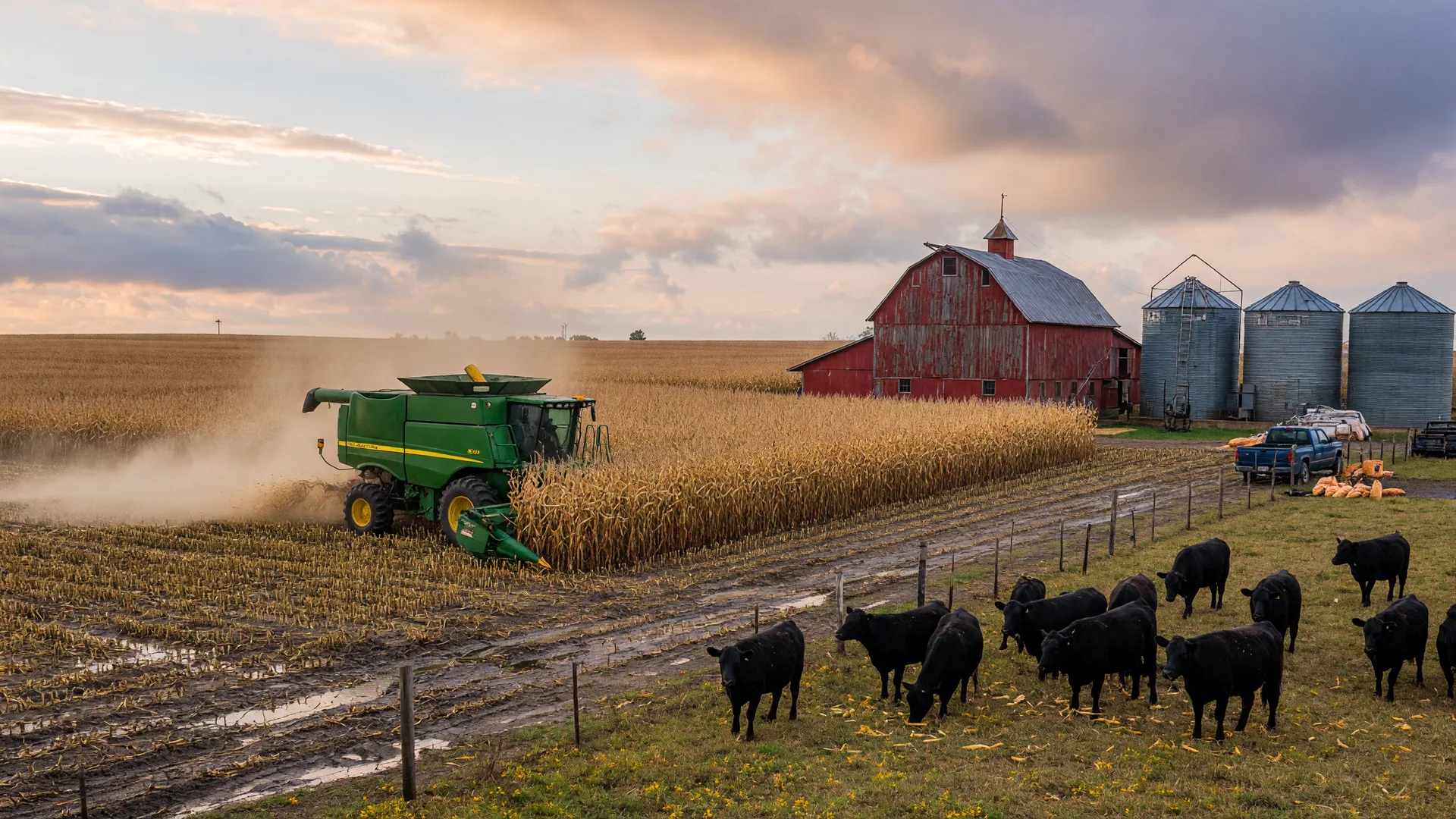
Wednesday was a sit-and-wait session ahead of Friday's big USDA report. December live cattle settled at $223.77, down 32 cents, with cash trade still not done for the week. November feeders fell $2.47 to $335.80. December corn slipped 6 cents to $5.02, November soybeans eased 5 1/2 cents to $12.97 1/2, and December Chicago wheat led the whole grain complex lower, down 17 3/4 cents to $6.86 1/2. Here is the straight talk on the last 24 hours of trading and the next 48, with the October WASDE and Crop Production report landing Friday at noon Eastern.
Cattle
Wed Oct 7 close: Dec live $223.77/cwt, down 32 cents. Nov feeder $335.80/cwt, down $2.47
What Happened
Wednesday's cattle session was a range day with no cash trade done. USDA reported no negotiated cash trades Monday across the five major feeding regions, and the Ag Center's October 7 report said no trade had developed in any region early in the week. Front-month October live finished up 37 cents to $221.60 while December gave back 32 cents to settle at $223.77, and November feeders took the biggest hit, down $2.47 to $335.80. Last week's cash had Southern Plains live at $226, up $4 on the week, with the North at $220 to $222 and light dressed trade at $348 to $350. This week, packers and feeders are still feeling each other out.
The ICE raid hangover is still in the tape. DHS/ICE operations in western Kansas packing towns, including Dodge City, Garden City, and Liberal, began in late September and disrupted plants, feedlots, and dairies, with more than 100 people detained. Cattle slaughter fell by roughly 17,000 head in a single week during the sweeps, ground beef hit a record near $6.92 a pound, and Texas ranchers reported thousands of fed cattle shipments delayed. Slaughter has recovered since: the weekly kill is back near 548,000 head, about 64,000 above the prior week but still roughly 20,000 below a year ago. Boxed beef held up Wednesday with the Choice cutout at $378.93, up 67 cents, and Select at $356.34, down $2.23. Beef Magazine notes futures ranged as cutout prices fell, with cash steady at recent levels supporting positive packer margins, and DTN's ShayLe Stewart says traders want fundamental support with no cash trade developed. Scott Shellady's Cow Guy Close on RFD-TV keeps the daily tape in front of the trade every afternoon, and the cash-versus-kill story has been the headline all week.
Next 48 Hours Outlook
Thursday and Friday come down to cash. If trade develops at or near last week's levels, the board has support. If packers sit on bigger showlists in the North, where Nebraska, Iowa, and South Dakota have larger market-ready supplies pressing, live cattle and feeders could give more ground. The next Cattle on Feed report does not land until Friday, October 23, so the next two sessions are all cash, boxed beef, and the kill. Watch whether November feeders can hold $335 after Wednesday's $2.47 spill.
Corn
Wed Oct 7 close: Dec contract $5.02/bu, down 6 cents, into Friday's WASDE
What Happened
December corn settled at $5.02 Wednesday, down 6 cents, after Tuesday's sharp bounce. The pullback was profit-taking and positioning ahead of Friday's report: traders booked gains off the recent highs while harvest advanced. USDA had corn 23 percent harvested as of October 4, slightly behind the five-year average, and ADM Investor Services notes it is the slowest harvest pace in seven years against a 27 percent average. Corn condition is at a season low, 54 percent good to excellent, after the wet late summer in the western Corn Belt, but a drier forecast is letting combines catch up in the previously inundated areas. The Rural Radio Network's October 7 market report put it plainly: traders are adjusting positions ahead of the big USDA report due Friday. Arlan Suderman, chief commodities economist with StoneX Financial, said traders are taking risk off the table, squaring positions for that report.
Friday's October WASDE and Crop Production report is the headline. The trade average for corn yield is 177.8 bushels an acre, down from USDA's September 178.5, and the Bloomberg survey shows traders expecting production to slip about 66 million bushels to 15.734 billion, with ending stocks up around 127 million bushels to 1.694 billion. The September 30 Grain Stocks report already surprised with 2025/26 corn ending stocks at 2.095 billion bushels, up 173 million from the September WASDE, and that hangover is part of why the market is cautious. Export demand is not picking up the slack either: the last two weekly corn sales reports came in disappointing, so the combine and the report are writing the next chapter, not the board.
Next 48 Hours Outlook
Thursday morning brings the weekly export sales report, and Friday at noon Eastern is the whole ballgame. If USDA cuts the corn yield toward the trade average of 177.8, the market can bounce off $5.00. If the yield holds or the stocks number comes in heavy, $5.00 becomes resistance. The dry-window forecast matters too: with the slowest harvest pace in seven years, every day of good combining weather puts more corn in the bin and more pressure on the deferred months.
Soybeans
Wed Oct 7 close: Nov contract $12.97 1/2/bu, down 5 1/2 cents
What Happened
November soybeans settled at $12.97 1/2 Wednesday, down 5 1/2 cents after being down as much as 9 3/4 cents at midday. Harvest pressure is the story: soybeans were 25 percent harvested as of October 4, slightly behind the five-year average, with 57 percent of the crop rated good to excellent, and a drier Midwest outlook should let combining pick up speed. The trade expects Friday's WASDE to show soybean yield at 52.9 bushels an acre, a hair above USDA's September 52.8, with tighter soybean reserves, and positioning ahead of that report kept a lid on the market all day.
The demand side is not all bad. Weekly soybean export sales jumped 78 percent week over week to about 1.03 million metric tons, roughly 38 million bushels, in the last reported week, and private exporters reported another 105,000 metric tons to unknown destinations on September 30. China's tariff deal left whole soybeans out, so the market is watching whether private Chinese crushers step in after state buyers did the heavy lifting. Darin Newsom of Barchart reads most of the recent grain bounce as technical and corrective buying after the markets got oversold, and Don Roose of U.S. Commodities says grain markets bounced off support while adding a war premium, all of it awaiting the WASDE.
Next 48 Hours Outlook
Beans are a WASDE and fund-flow trade. The next two sessions show whether the market holds $12.90 to $13.00 into Friday, and Thursday morning's export sales report gives the next read on demand. A steady corn market helps beans hold the line. If the WASDE trims the yield or tightens carryout, the $13 handle comes back fast; if the numbers land heavy, the liquidation that started in late September has more room to run.
Wheat
Wed Oct 7 close: Dec Chicago SRW $6.86 1/2/bu, down 17 3/4 cents
What Happened
December Chicago soft red winter wheat settled at $6.86 1/2 Wednesday, down 17 3/4 cents and near the daily low, leading the whole grain complex lower. Kansas City December hard red winter fell the same 17 3/4 cents to $7.38 1/2. The selloff was technical selling that resumed after Tuesday's rebound, with managed-money funds lightening net long positions ahead of Friday's WASDE and a firmer dollar index near a 1.5-year high pressing the entire complex. Analysts surveyed by Bloomberg expect the report to show U.S. wheat inventories up 4 million bushels to 721 million, and weekly export sales are forecast in a 200,000 to 500,000 metric ton range.
The Black Sea headline machine keeps running. Turkey and the UN brokered a new round of Russia-Ukraine talks on a Black Sea ceasefire to protect grain shipments, announced October 1, and Ukraine says it has received four ceasefire proposals, from Turkey, Egypt, India, and the U.S., three of them involving Black Sea grain exports. But Ukraine's agriculture minister said in late September he sees no positive signs of a ceasefire in the coming months. Analysts estimate a real deal could let Russia restore up to 80 percent of its Black Sea grain-terminal capacity, which is why every round of talks sells the premium. A Saudi import tender is supporting demand sentiment on the sidelines, but the ocean moves the quote, not the spreadsheet.
Next 48 Hours Outlook
Wheat is a WASDE and headline trade. Friday's report has inventories creeping higher, and Thursday morning's export sales report answers whether U.S. wheat is catching any of the demand, with the Saudi tender in the background. If the ceasefire talks stall, the premium snaps back in a hurry; if they produce anything real, $6.80 gives way. Watch the dollar too: a firmer dollar near a 1.5-year high is a headwind for every grain.
What This Means for
The Bottom Line
Wednesday was a wait-and-see session into Friday's USDA report: December live cattle down 32 cents to $223.77 with cash trade not done, November feeders down $2.47 to $335.80, December corn down 6 cents to $5.02, November soybeans down 5 1/2 cents to $12.97 1/2, and December wheat down 17 3/4 cents to $6.86 1/2. The next 48 hours come down to cash cattle, Thursday morning's export sales, and the October WASDE at noon Eastern Friday. For Wisconsin farm and land sellers, the through-line is unchanged: the cattle herd stays tight, well-drained Wisconsin ground gets attention from a wet Corn Belt, and land values held firm through the first half of 2026 with fall auctions the next test. If you have been thinking about listing, the fall window is open and the buyers are real.
I watch these markets every day because they tell me what the buyers I work with are thinking. If you want an honest read on what your farm or land is worth in this market, give me a call. I will walk your ground with you and tell you straight what I see.
Read More on the Site
This update lives under our Cattle and Cash Crops section, where you can find deeper guides on cattle property, crop land, and what Wisconsin rural land is really worth.